
The Packaging and Packaging Waste Regulation (PPWR) introduces a new set of requirements designed to make packaging safer, more sustainable, and easier to recycle across the European Union. One of the most significant early obligations is Article 5, which focuses on substances of concern in packaging.
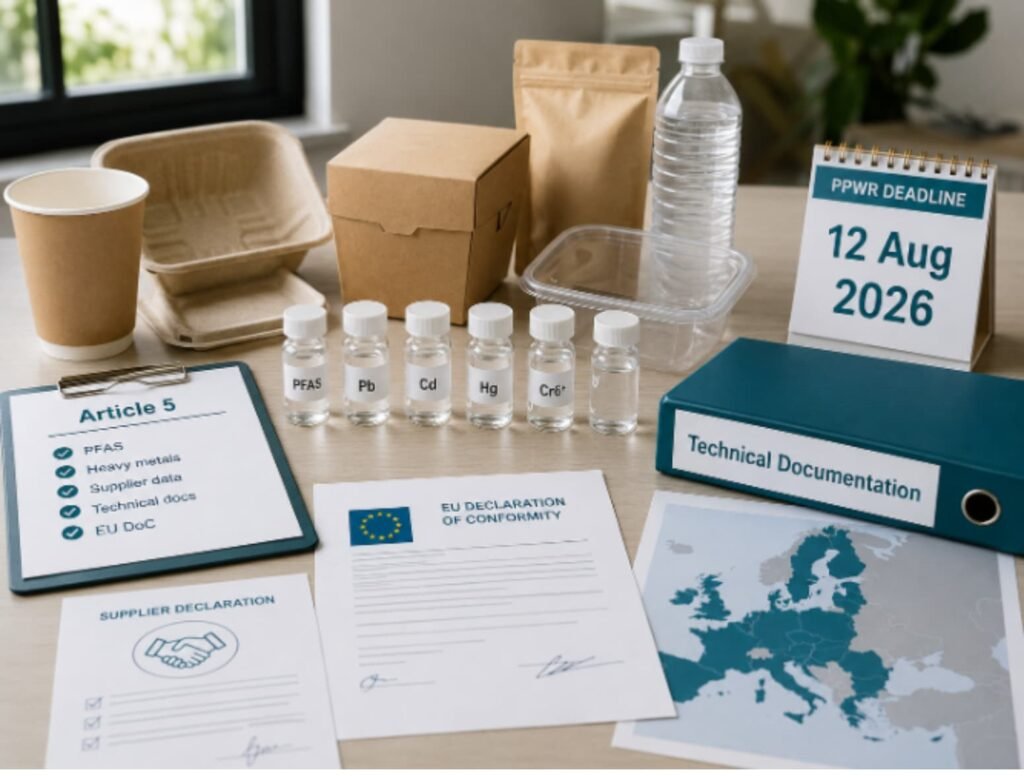
As businesses prepare for PPWR implementation, Article 5 will require manufacturers, importers, and other economic operators to demonstrate that packaging materials do not contain restricted substances above specified limits. With the first requirements becoming applicable on 12 August 2026, companies must begin evaluating their packaging portfolios, supplier information, and technical documentation well in advance.
What Should Be the Main Points Of Focus?
Article 5 requires packaging to be designed and manufactured in a way that minimises substances of concern that may negatively impact human health, recycling processes, or the environment.
The regulation specifically targets hazardous substances that can hinder material recovery, create environmental risks, or affect the safe use of packaging.
Key Requirements
- Heavy Metals Limit
The combined concentration of lead, cadmium, mercury, and hexavalent chromium must not exceed 100 mg/kg in packaging or any packaging component.
These heavy metals have long been associated with environmental and health concerns. By limiting their presence, PPWR aims to reduce harmful substances entering recycling streams and waste management systems.
- PFAS Restrictions
From 12 August 2026, food-contact packaging cannot be placed on the EU market if per- and polyfluoroalkyl substances (PFAS) exceed the limits established under PPWR.
PFAS are often referred to as “forever chemicals” because they persist in the environment for extended periods and can accumulate over time. They are commonly used in food packaging applications due to their resistance to grease, oil, and moisture.
- Technical Documentation Requirements
Compliance with Article 5 must be supported by documented evidence.
The concentration of PFAS and heavy metals must be recorded within the technical documentation that supports the EU Declaration of Conformity. This information must be available to demonstrate compliance during conformity assessments and regulatory inspections.
- Alignment with Existing Regulations
Article 5 does not replace existing chemical safety requirements. Businesses must continue to comply with other relevant legislation, including:
- REACH Regulation (EC) No 1907/2006
- Food Contact Materials Regulation (EC) No 1935/2004
This means companies may need to assess packaging against multiple regulatory frameworks simultaneously.
Implementation Of Deadline & Challenges (Deadline: 12 August 2026)
Article 5 is among the first PPWR obligations becoming applicable. While the deadline may appear distant, many organisations face significant preparation work before they can demonstrate compliance.
Supply chain complexity, data collection challenges, and testing requirements can make implementation a lengthy process.
Main Challenges
- Obtaining Reliable Supplier Data
Many businesses rely on a network of suppliers for packaging materials and components. Obtaining complete and accurate information regarding chemical composition can be difficult, particularly when suppliers operate across multiple countries and jurisdictions.
- Identifying and Testing PFAS
PFAS can be present in various food-contact packaging materials. Companies may need additional testing, supplier declarations, and material assessments to determine whether restricted substances are present and within permitted limits.
- Building Technical Documentation
PPWR places strong emphasis on documented compliance. Businesses must establish processes to collect, verify, organise, and maintain supporting evidence for conformity assessments and the EU Declaration of Conformity.
- Managing International Supply Chains
Packaging compliance often depends on information from manufacturers, converters, material suppliers, and distributors located in different regions. Coordinating data collection and maintaining consistency across the supply chain can be a significant operational challenge.
How Can We Help?
Preparing for Article 5 requires more than simply understanding the regulation. Companies must also establish practical systems for collecting data, managing documentation, and demonstrating compliance.
Supplier Data Collection
Digitally collect declarations, test reports, material information, and compliance evidence from suppliers through a structured process that reduces manual administration.
Technical Documentation Management
Maintain Article 5 documentation in a centralised compliance platform, helping ensure information remains organised, accessible, and ready for inspection.
PPWR Compliance Assessment
Identify packaging materials that may be at risk of non-compliance and prioritise corrective actions before regulatory deadlines take effect.
EU Declaration of Conformity Support
Ensure the evidence required to support Article 5 compliance is available for conformity assessments, audits, and regulatory inspections.
Key Takeaway
- Article 5 of the PPWR requires packaging to be designed and manufactured with substances of concern kept to a minimum.
- The combined concentration of lead, cadmium, mercury, and hexavalent chromium must not exceed 100 mg/kg in packaging or packaging components.
- From 12 August 2026, food-contact packaging placed on the EU market must comply with PFAS restrictions under PPWR.
- Businesses must maintain technical documentation showing PFAS and heavy metal concentrations as part of the EU Declaration of Conformity.
- Companies should begin collecting supplier data, testing materials, and building compliance records now to avoid disruption before the deadline.
Conclusion
Article 5 marks one of the earliest and most important PPWR requirements coming into force. While the regulation focuses on limiting substances of concern such as PFAS and heavy metals, compliance goes beyond testing alone. Businesses must be able to demonstrate conformity through accurate supplier data, robust technical documentation, and a well-maintained EU Declaration of Conformity.
With the 12 August 2026 deadline approaching, organisations that begin preparing now will be in a stronger position to address compliance gaps, reduce regulatory risk, and maintain uninterrupted access to the EU market. Building a structured compliance process today can help avoid costly challenges tomorrow.
Need support with your PPWR journey? PPWR Conformity by PackIntelX helps businesses simplify compliance, manage documentation, and prepare for evolving packaging requirements all in one place!